
One man’s honest and humble opinion.
Written by Recal Training founder and head coach, Anthony Lorubbio
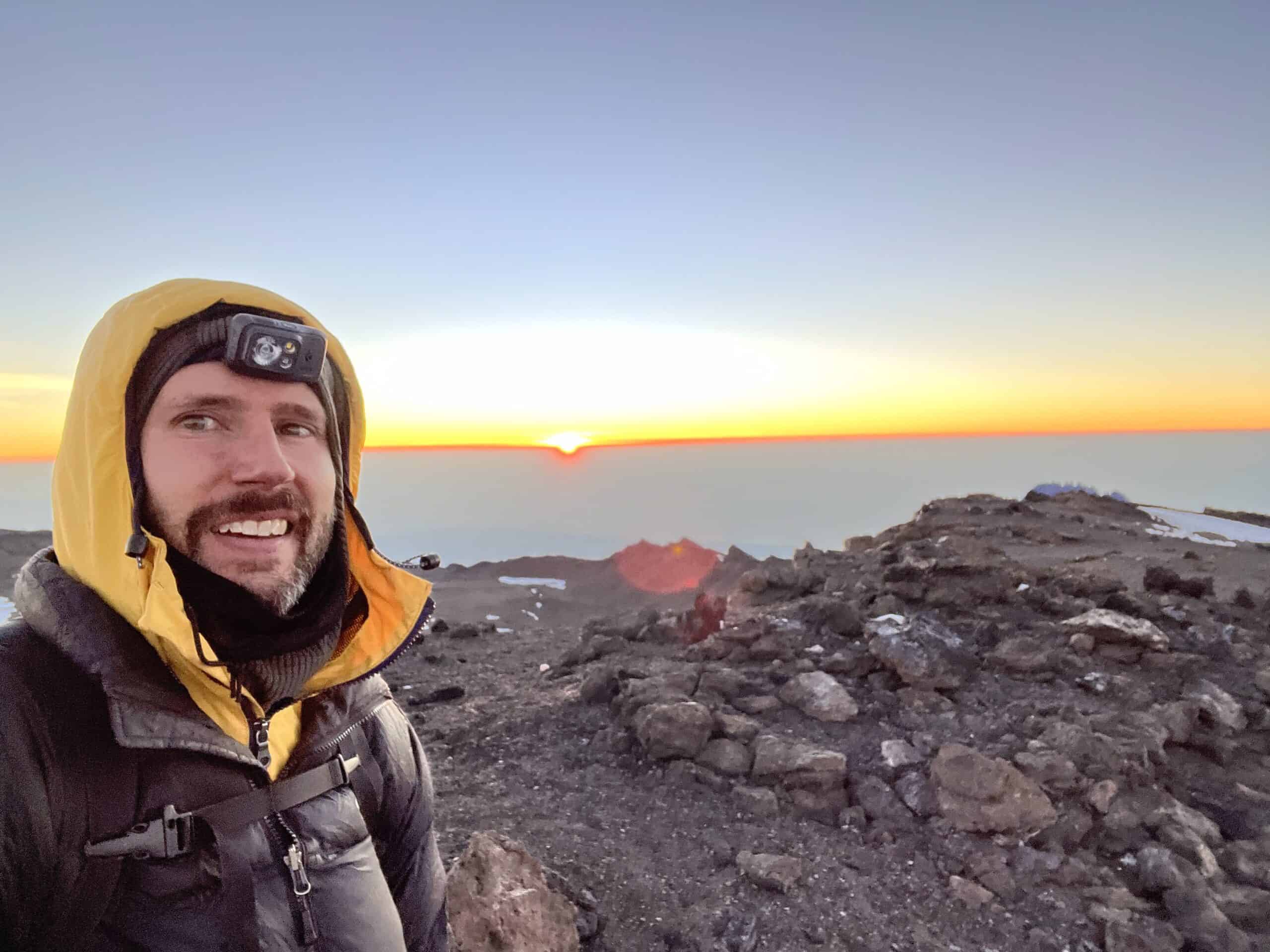
I got down from Kili 3 days ago.
People have asked, “Is Kilimanjaro ‘actually’ hard?”
And here’s my answer:
In the moment: “Wtf am I doing?! Never. Again.”
After coming down: “Meh, I could totally do that again. For sure. It wasn’t that bad.”
Let me walk you through how I came to this answer.…
But before I explain,
I want you to know about my upcoming workshop on high altitude prep for Kili (including how to breathe optimally on the mountain). Your complimentary access link is below.

Ok, let’s begin.
If you’ve got a Kilimanjaro climb planned, allow me to break things down, admit my mistakes, and disclose the things I underestimated…. all so that you’ll be better prepared for your challenge ahead.
First off: let’s be clear about one thing. Kilimanjaro does not require “technical mountaineering” skills. It’s not hard in that way. It’s hard because of the altitude. Plus, it’s a long way up and down. So the distance can get ya.
Secondly, I made a big mistake on summit night. One that I don’t want you to make on your climb. Before I go through my list of three hardest parts of Kilimanjaro, let’s get into that first….
The pace was set. And I broke free from it….
For background: I was climbing in a group of 8 people, including myself. Various ages (30 – 60), fitness levels, experience levels, “stoke” levels, etc….
Our guide (highly qualified) was in the front, setting the pace — a good pace that made perfect sense for everyone to manage their way up the mountain. It was a pace that would enable us to reach the summit (from Barafu camp aka “basecamp”) in about 8 hours — roughly 8 am.
I was kickin’ it in the back of the line, with my mouth taped shut (yes, I was attempting to do the climb completely nasal-breathing).
I was feeling GOOD. Energy levels high. Breathing dialed in. But each time we paused to catch our breath (ha), I got more and more frustrated. I just wanted to GO, open up the throttle, and push myself. As much as one might say it’s “not a race” I have a terrible, undisciplined approach to that concept. And for me, I wanted to test what I’m capable of.
So, using sign language (tapping my chest, making a ‘walking’ action with my pointer and middle finder, and pointing uphill), I communicated I wanted to GO to the assistant guide, Erick, behind me. He got attention of our head guide, Robert, who confirmed the message with me.
He paired me with another guide, Gideon, asked if anyone else wanted to ‘go’ — the 60-year-old in our group, Sean, popped right out of line and accepted the invitation — and we were off…. at a very fast pace, jumping ahead of other groups, taking a more direct line up the mountain.
This felt like a great decision. For about 60 minutes. But we’ll get there…
Ok, time to dive into my list of ‘Three Hardest Parts of Kilimanjaro’ plus a nice honorable mention list at the bottom (you don’t want to miss that).
The Hardest Part of Kilimanjaro: #1
Summit night.
Ok, this might be obvious. But I’ll be honest with you. I actually expected to coast my way to the top. Yep, big ego here, I guess….
I was coasting… as you’ve already read. I was coasting in the back of the group at the pace that was set by our guide.
It was a good idea to break free from the group… up until about 400 meters (~1,300 ft) from the top.
—> FYI: on summit night, you go from 4,600 meters to ~5,900 — so 1,300 meters, or 4,251 ft, UP in total
Then, right around 5,500 meters, things started to get funky.
I’m talking coordination became harder, dizziness set in, wobbly feet, inability to focus and really SEE each step I was taking, and feeling increasingly nauseous. My breathing, surprisingly, was well under control — steady and deep — (although hard, don’t get me wrong…I was working hard to inhale full, big breaths). But working nonetheless, with my mouth taped shut, just like I planned it.
—> I will say, my intercostal muscles (rib cage) were getting increasingly fatigued. And even a little cramp/pain was developing on my right side ribcage. I’ll talk more about that later.
Amidst this funkiness from moving faster than I should’ve been, we paused for a bite to eat. I clumsily ripped off my mouth-tape to shove an energy bar in my mouth. The tape never came on again…
- I continued to breathe with my nose, however every 5 breaths or so I took a rapid, shallow breath with my mouth. Very different style than all the other breaths I’d taken up to that point over the 8-day climb.
I regret one thing here: that I didn’t have the presence of mind to simply throw in my nasal dilator — this would’ve limited the resistance from nose-breathing and opened up the passage to take fuller, quicker breaths yet keep it nasal. Dang. Oh well.
Like I said, in the moment, I felt drunk, in a way. Couldn’t control my feet, my arms were hanging down to my sides. I cursed my own ambition to ‘go fast.’ I cursed Gideon for setting this incredible pace. I cursed anyone who had stepped foot at this altitude before — and somehow convinced the rest of us that it was ‘ok’ and practical for us mere human beings to exist up here.
While nausea was a consistent feeling (I legit thought at any moment I would pause, turn my head, puke, wipe my mouth, and then continue right on going), I could fend it off by bringing my focus to the ‘next’ breath. And miraculously, it would go away. For a few breaths, at least.
On top of the nausea, I felt drunk. Or maybe they’re kinda one in the same? It was like I walked out of the optometrist after he or she put drops in my eyes that dilate my pupils. My eyes just couldn’t seem to focus on the steps right in front of me. It took incredible concentration to keep moving forward and not trip over my own feet.
Then, out of nowhere, we came up on Stella Point — the rim of the volcano.
A sense of peace came over me. I knew at that point we were going to get to move at a much more gradual pace, with less tricky footing. All we had to do now was move from Stella point to Uhuru Peak (a manageable 144 meters (472 ft) up over 1.1 km (0.68 miles) of distance).
So, broad gait and all (felt like a wide-legged cowboy with boots and spurs, shuffling his way through the swinging saloon doors), we moved somewhat efficiently past the ice and glaciers, on the path toward the true summit.
That’s the story of the #1 hardest part of Kilimanjaro — and how I pushed through it to reach the summit. Now on to #2.
The Hardest Part of Kilimanjaro: #2
The way down
The 2nd hardest part — or maybe the 1st hardest if you actually stick with your guide’s pace…. or suffer from bad knees — is coming down.
“It’s all downhill from here.”
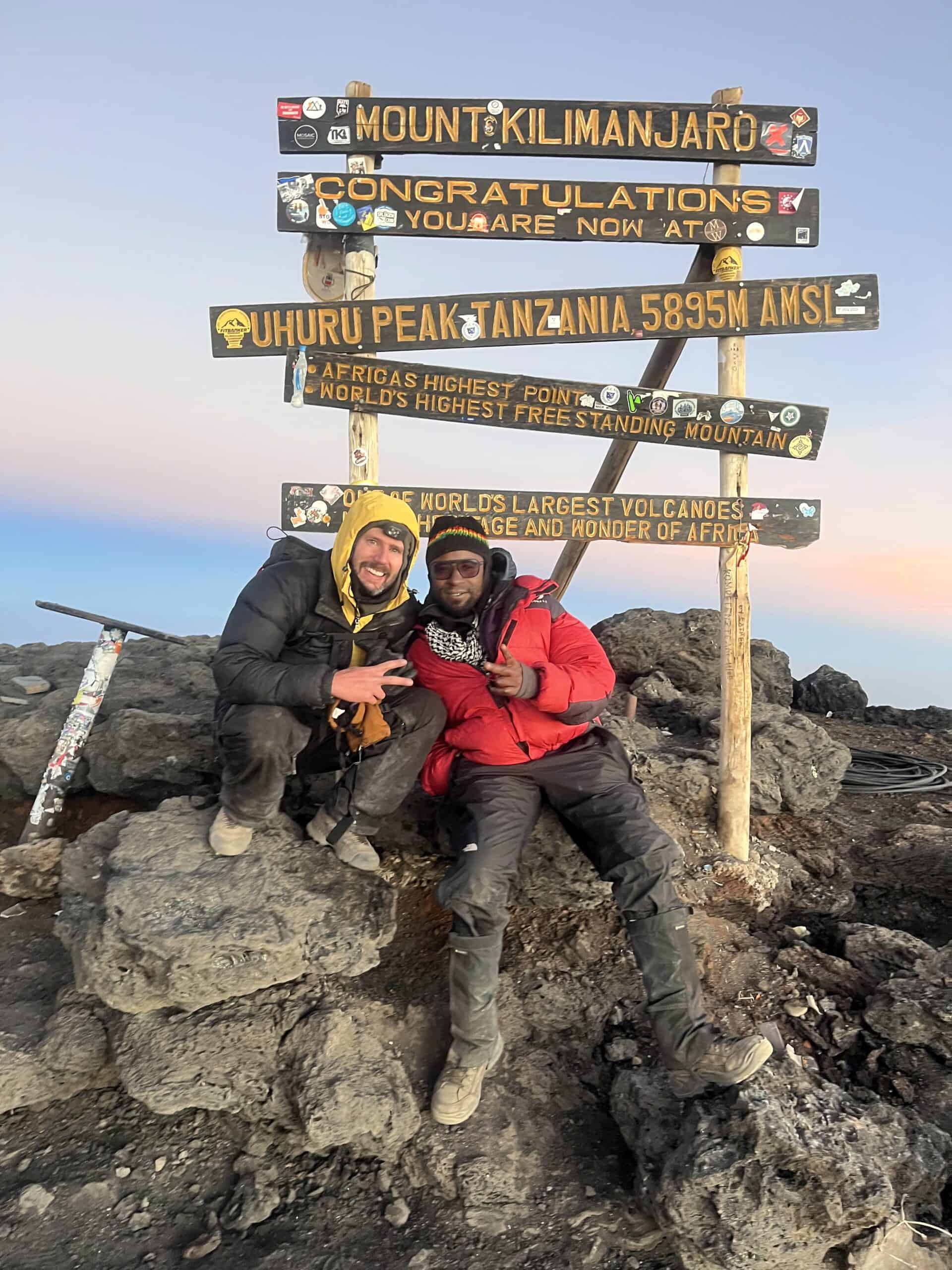
…is what I said jokingly to Sean while standing at the summit. Oh how literal that ended up being.
At the summit, you are HIGH, both figuratively and literally. 5,895 meters (19,341 ft). And riding the high of having summited the roof of Africa.
Camp later that night (Mweka Camp) is at 3,100 meters (10,170 ft).
That means you have to descend a whopping 2,795 meters (9,171 ft) in one morning/afternoon.
—> AFTER having climbed UP 1,300 meters (4,160 ft).
—> In extreme altitude.
—> On little-to-no sleep from your 11 pm wake-up call.
This is no joke. And quite possibly the most underrated challenge of a Kili climb. The down-climb.
At first, you casually stroll down a clean dirt path from Uhuru Peak to Stella Point — beautiful, sun-filled views along the way.
Then, after Stella Point, things get rocky and a bit crumbly. You zig-zag on the same switchbacks from which you ascended. Some bigger plops down — carefully with your knees. Maybe for an hour.
Then at some point, you veer off of your up-climb route and into a massive scree field (scree: (noun) small, loose rocks that move under your feet). This begins your “screeing” experience. It’s like skiing, but there’s no snow. And a lot less smooth.
This takes about 1-2 hours, depending on your scree-ability and balance. Your legs are consistently bent in this action (firing up your quads — holy cow), as you shift and turn, left-right-left-right.
—> Don’t forget your gaiters here. This will help keep the small, pesky rocks out of your shoes.
Then after you’ve exhausted your shaky, dehydrated, exhausted thighs (don’t forget to hydrate, folks), you hit more solid ground and descend through rocks, with a small bit of scramble type moves all the way down to camp.
That is about ⅖ of your descent battle. Not quite halfway.
From here, after a short nap — maybe an hour or so — in your tent that was left at basecamp, and after a re-fuel “brunch,” you begin the very long walk down from Barafu camp to Mweka camp. This is about 1,500 meters down.
You will move on a gradually descending trail – pretty comfortable, to be honest – through the high, dry dusty desert. Into high alpine vegetation. Then into more rainforest-like vegetation. The terrain moves from dust to dirt to mud (depending on your rainfall, of course). There are some steep drops and rocky steps that will challenge your weak thighs and creaky knees here.
Finally, if you move efficiently enough, you will get to Mweka camp before sunset (long before sunset if you’re really moving, but it was slow-going in my group). And it’s a welcome sight to say the least.
So there it is, the underratedly difficult part of Kili…. that will test your physical and mental resilience: the downhill.
The Hardest Part of Kilimanjaro: #3
Breathing
The 3rd hardest part? Breathing
Now, remember, this is one man’s perspective.
But for me specifically, the third hardest part of climbing Kilimanjaro was BREATHING — as often and as forcefully as I needed to feel like I was getting enough air.
As you probably know, it is not a pure ‘lack’ of oxygen in the air at this high of altitude — the number of oxygen molecules is at the same ratio as at sea level.
The difference is the air pressure.
What that means, in no uncertain terms, is instead of air rushing into your lungs nice and easy after an exhale, as it does while near sea level, it requires you to WORK HARD to PULL the air into your lungs on an inhale.
And for me, given I was diligent about nasal breathing my way to the top, the hard part of my experience was simply… breathing. Additionally, on my right side, one of my intercostal muscles (the ones in between your ribs) started to cramp. That didn’t go away for a good two hours — the final two of the climb.
Breathing as hard as the situation called for, it tired out my diaphragm, intercostal, and abdomen muscles. It’s no joke up there. Seriously.
My advice? Don’t sleep on training your breathing muscles. It could make the difference between a successful summit vs aborted mission.
Hardest Part of Kilimanjaro: Honorable Mentions
Ready for the hard parts that didn’t make the top 3, but very much worth mentioning?
Good. Here we go.
#1 Moving about your tent. Early in the morning (with headlamp), after a long hike, before bed, with an altitude headache, etc.
Surprisingly, crawling around your tent, with all the awkward pulls, drags, carries, knee-bends that it requires, puts a lot of strain on your low-back, core, knees, groin, shoulders, and more. I suggest you do a good deal of functional movement training and bolster those joints, back, and your flexibility. Plus the down-climb will appreciate this work as well.
#2 The food intake.
Holy cow, our guide staff wanted us to EAT. 3 meals a day, multiple courses, we were encouraged to put down as much as we could handle. It was like a marathon of eating. Soups, rice, noodles, “vegetable sauce,” pancakes, eggs, and even one night of “pizza” — we were encouraged to get as much down the hatch as possible.
The food got a bit monotonous, flavorful in its own unique way, but a bit hard to stomach at times despite best efforts from the cook staff.
And fiber was at a premium. Which brings me to our next challenge…
#3 An “irregular” schedule for your bowels. Plus, simply keeping that system in-check and working in your favor, not against you.
If you’re anything like me, you’ve got a ‘normal’ schedule pretty well flushed out (ha). Are you a person who’s ‘on the move’ right after you wake up? Or a post-breakfast flusher (like me)? Or maybe you’re a coffee erupter? Hell, you might even be a cigarette igniter. This breathwork coach isn’t ignorant to the idea that some of you are smokers out there.
Whatever your normal ‘pattern’ is, you can count on NOT counting on normal bowel movements on the mountain. And fiber is at a premium in the foods you eat on the mountain.
That leaves you with unease, to say the least.
Just a consideration for some of you out there. Especially for the gun-shy few that …. ‘back things up’ while on the road. Bring some fiber-rich foods. Bring anti-diarrhea pills. And bring your Smooth-move tea. You might need any or all of these special tools to keep yourself ‘regular’ on Kili.
There you have it, friends. The hardest parts of Kilimanjaro, ranked list of top-three, plus three honorable mentions.
If you’d like to join my upcoming workshop — where I’ll be talking mostly about how breathwork training is the missing piece of most peoples’ altitude prep, here’s a link to register:
There will be time for Q&A, and I’ll be more than happy to address the above challenges — and other questions you have — during that time.
See you there!
Anthony
Founder & Head Coach
Recal Training